Whether you’re just starting to build a stockpile to help combat ever-rising grocery costs or if you have a preppers heart and are determined to finally get started, a stockpile is always a great idea. It can be hard to afford weekly groceries though, let alone have enough money left over to build up a nice sized preppers pantry. Building a stockpile might sound overwhelming and expensive, but even if you only have $5 extra a month to put toward long term food storage, it can absolutely be done. Always remember that a prepper’s pantry is never ever done, is always a work in progress, and that any stockpile at all is a million times better than no stockpile. Let’s get started!
The Best Way to Start Your Stockpile
Starting a stockpile doesn’t mean you have to empty your bank account.
The key is to take small steps and make the most of every great deal you find.
My husband always says “one for now, one for later.” Truly the best way to start your stockpile is to just start.
When you go grocery shopping for your weekly groceries, take a look at your list.
Are you buying two cans of chili beans to use this week? Throw 4 or 6 in the cart instead. Notice a sale on meat? Stock your freezer as much as your stockpile budget will allow.
Meal Plans and Food Items – Your Stockpile Master List
Creating meal plans is a great way to build your stockpile of food items strategically.
Plan your meals around what’s on sale, and you’ll save a whole lot in the long run.
Keep a list of things you need and want in your stockpile to avoid impulse buys at full price.
When I’m considering what to buy every month, I always price compare as I go. It has literally never been easier.
I compare my Walmart app to Azure Standard, Publix, and Winn Dixie sales.
Often Azure Standard is the cheapest for things like organic flour or frozen berries.
Sometimes Publix, our most expensive grocery store, blows everyone else out of the water with BOGO sales.
Stock up on what’s on sale but always have a running list of what you want. Chip away at it as you can.
Building Your Stockpile on a Tight Budget
Arguably, the cheapest way to start a stockpile is to just buy huge bags of rice and beans.
While this will keep you alive, it will be a boring survival situation should you ever need to use them.
Look at what your family eats on a regular basis that is already shelf stable. Pick up more of those as your budget allows.
If you have an extra $25 to throw at stockpiling, you can actually build up quite a pantry in a short amount of time.
I’m writing this in 2023 when prices are completely out of control and I still find this to be the case.
Buying in bulk at a place like Sam’s Club can save you big bucks (sometimes, always check unit prices to avoid making a rookie mistake!) and make your stockpile grow in no time.
Stockpile for Emergency Preparedness
Having an emergency stockpile is always a good idea.
Natural disasters and job loss can hit us unexpectedly, but with a well-established stockpile, you’ll have peace of mind knowing you have enough food and household items to get you through tough times. 2020 made a lot of preppers out of normal every day families. My husband’s “ah ha” moment was when I sent him to the store for toilet paper and canned diced tomatoes and he came home without either. He said “you have no idea what it’s like to have your wife send you to the grocery store for two simple things and have to come home empty handed. I’ll never go through that again.” He immediately bought sturdy wire shelving and started buying two or three extra things each time he went to the store. He really meant what he said that day and there have been so many times since then that it has come in handy. Hurricane Ian is a recent example that comes to mind. Go hard on stockpiling while things are plentiful so you don’t have to be a drain on the system when they’re not.
Smart Stockpiling for Smart Deals
Taking advantage of sales and loss leaders at your local store is a smart move. Create a stockpile fund to make the most of those great deals. Don’t pass up a good sale on things you know you’ll use. Are you sensing a theme here? DON’T stockpile things you don’t already eat! BUT, if your local grocery store has a BOGO sale on your favorite pasta sauce, stock up! Buy a year’s worth if you can. See a clearance rack of dented pasta boxes? Buy what you can
Non-Perishable Items: The Stars of Your Stockpile
Non-perishable items like pasta sauces, peanut butter, and canned goods are the stars of your stockpile.
They have long shelf lives and are versatile in many recipes.
Plus, they’re perfect for stocking up on when they go on sale.
This doesn’t mean to buy the most preservative-laden junk you can find just because it’s shelf stable.
Instead, buy cans and dry goods and learn to store them.
We use Azure Standard for lots of things like flours and oatmeal.
I store them in 5 gallon buckets with gamma lids in our pantry.
Just one purchase of 25 pounds of oatmeal will last our large family months without even trying to stock up.
The Little Planning That Goes a Long Way
With just a little planning, you can save big on your grocery stockpile.
Keep a running list of what your family most likely needs and take advantage of sales to build up your stockpile gradually.
A little bit here and there will add up to a whole lot of savings!
Making the Most of Your Small Space
Even if you live in a small house with not much space, you can still build an impressive stockpile.
Opt for larger packages of stable foods and use every nook and cranny to store your stockpile.
It’s all about making the most of what you have! We live in 1401 square feet with 5 kids and 2 adults in our family.
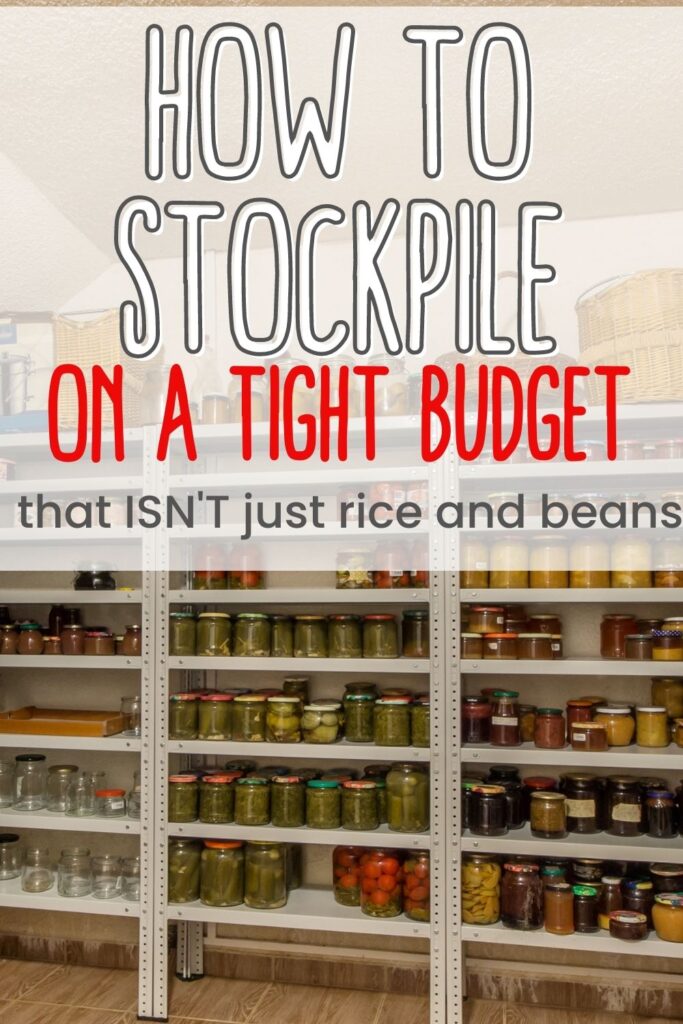
My husband built reinforced shelves in our little pantry and I “stock them to the rafters” as the Canadian Prepper says.
I don’t buy things I know we won’t use just because they’re on sale. I buy what I know we’ll actually eat and I buy a lot of it.
I store it in the places that don’t get used, like that cabinet above the fridge that no one knows what to do with.
“Decant” things (fancy term Youtube made popular.
Means to take things out of their packaging so it takes up less space).
Stockpile for Your Peace of Mind
Having your own stockpile will give you peace of mind during emergencies or food shortages.
With an emergency food supply on hand, you’ll be prepared for any short-term outage that comes your way.
The First Step to a Great Stockpile
The first step to a great stockpile is to focus on non-perishable items.
These are the foundation of your stockpile and will keep for a long time, allowing you to use them later when you need them the most.
Remember though that the rule still applies – eat what you store and store what you eat.
Avoiding Food Waste with Your Stockpile
With smart planning and rotation, you can avoid food waste in your stockpile.
Keep track of expiration dates and use older items first.
This way, you’ll always have fresh foods in your stockpile.
This was a mistake we made when we first got married and started our sorry excuse for “homesteading”.
The foods we purchased were almost like a collection.
We’d buy flats of cans at Aldi and be proud of ourselves for having a stockpile in case of bad winter storms. Instead, we collected a bunch of cans of black beans that we never ate. Create a well thought out stockpile and then rotate through the items in it. Use a couple cans of tomatoes? Pick up at least a couple more when you go back to the store.
How Much Cash Should You Stockpile
This one is hard and obviously most families are just trying to survive from paycheck to paycheck right now.
The general rule of thumb has always been to have $1000 on hand, but how many people can swing that these days? I can tell you that when we went through Hurricane Ian, we needed cash for everything because we went weeks with little to no electricity.
People would wait in line for gas just to get to the pump and realize they couldn’t pay for it. $1000 was also pretty scary to have when law and order were going out the window.
Starting a stockpile on a budget is easier than you think.
With a little planning, smart shopping, and a master list of essential items, you’ll build a stockpile that will keep your bank account happy. Remember, it’s all about taking small steps and making the most of every great deal you find. Happy stockpiling!
Leave a Reply